

Driving Community Health Systems Resilience Through Financial Inclusion and Smart Coordination
In Tanzania, community health workers (CHWs) are often the first point of contact for care, particularly in underserved and hard-to-reach communities — monitoring child growth, preventing the spread of disease, delivering critical health education, and connecting people to lifesaving services. Their support is also vital to achieving universal health coverage.
Although several CHW initiatives have emerged over the years to support service delivery, they have largely operated in parallel, with uneven alignment across regions and programs. As a result, many focus on only a few health areas, struggle with management and training challenges, and continue to depend on donor support. This has underscored the need for a more unified and integrated CHW approach in Tanzania, one that can serve all communities while reflecting Tanzania’s cultural and socioeconomic diversity.
The Need for a Unified, Government-Led Approach
The good news? Change is already underway. Today, the Government of Tanzania is showing what’s possible when CHW initiatives are standardized and coordinated, existing government systems are enhanced and financed, and frontline care is sustained.
In January 2024, Tanzania’s Ministry of Health, launched its Integrated and Coordinated Community Health Workers (ICCHW) Program to standardize and coordinate the recruitment, training, and deployment of CHWs, while digitizing monthly stipend payments for thousands of CHWs nationwide. Until recently, CHW onboarding and stipend payments were managed by a patchwork of public health partners, each with its own recruitment process, stipend amount, and disbursement methods. This fragmentation made it difficult for the government to track who was working, where, and whether they were receiving consistent and timely stipends for their work.
Digital Payments as a Catalyst for Inclusion and Coordination
The Digitalizing CHW Payments Program is addressing many of these challenges by building a unified, government-led digital payment platform to deliver monthly stipends to over 137,000 CHWs by 2028, with funding support from Gates Foundation. Looking ahead, the platform is designed to expand, eventually covering other categories of contracted workers such as casual laborers and other workers. Leveraging Tanzania’s growing digital public infrastructure, the platform is enhancing and enabling data exchange across existing financial, human resource, and performance management systems to facilitate CHWs registration, payroll, and stipend disbursement.
Led by the Ministry of Finance and working in collaboration with the Ministry of Health, the Prime Minister’s Office Regional Administration and Local Government, University of Dar Es Salaam, and IntraHealth International, a Global Communities subsidiary, a cross-ministerial task force of government software developers and systems analysts is enabling the development process and setting the foundation for an efficient, scalable, and secure payment system.
This is both a technical upgrade and a systemic shift in how governments support frontline workers and advance community health delivery.
From the outset, the system was designed with inclusion in mind. Many CHWs, especially women and those in rural areas, lacked access to bank or mobile money accounts. The platform incorporates Know Your Customer (KYC) processes using Tanzania’s National Identification Number, ensuring that CHWs can be verified and paid securely. In addition, a dedicated bank account that is pre-funded by government and donor sources was established to hold stipend funds, improving transparency, and coordination.
To bring the new system to life, the team worked hand-in-hand with CHWs, facility staff, and district leaders on the design and to conduct subsequent user acceptance testing, ensuring the platform was intuitive, reliable, and responsive to local realities. Following successful trials, Tanzania has begun rolling out the digital payment platform in phases starting with ICCHWs priority regions, where transactions were validated through both mobile money and bank transfers. With sustainability and national ownership at the forefront of the process, a cadre of facilitators was trained to cascade their knowledge across districts and health facilities, strengthening the capacity of Tanzania’s health system from the ground up.
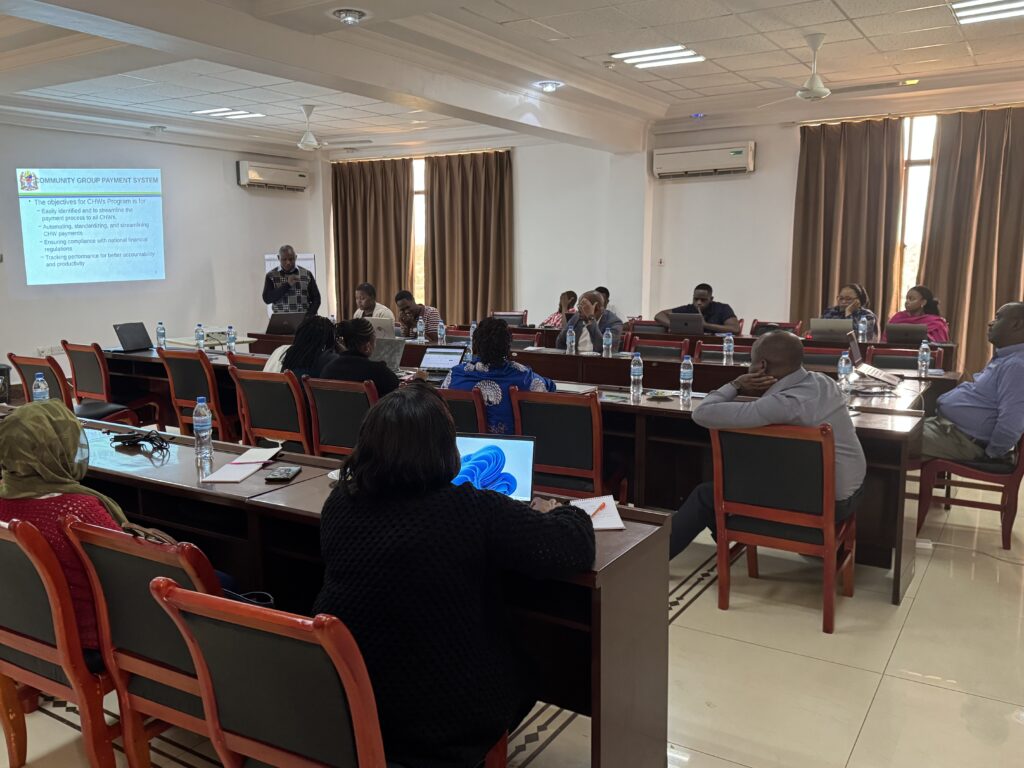
The initiative is already demonstrating how digital payments can improve government efficiency, strengthen public financial management, and expand financial inclusion for remote workers. In the months of July, August, and September, over 7,600 monthly CHW stipends were successfully processed. User training sessions were conducted across twenty-three priority districts, with two more scheduled to take place in the next month.
As a next step, Global Communities will be conducting research to generate insights on how mobile phone affordability, security, perceived benefits, digital literacy, and norms affect access to and use of digital payment systems for last mile service providers, funded by Gates Foundation. We also hope to conduct nationally representative implementation research on other aspects of the initiative to assess lessons learned and impact to support further scale up in Tanzania, as well as inform other country’s efforts.
A Replicable Model for Strengthening Community Care Systems
Tanzania’s CHW payment platform offers a replicable model for other countries seeking to better coordinate and incentivize health workers, improve accountability and transparency, and build resilient health systems. It provides a glimpse of how smart systems and committed leadership can transform everyday realities for those working on the frontlines of health. Most importantly, it shows that financial inclusion isn’t a sideline issue — it’s a frontline strategy.